Description
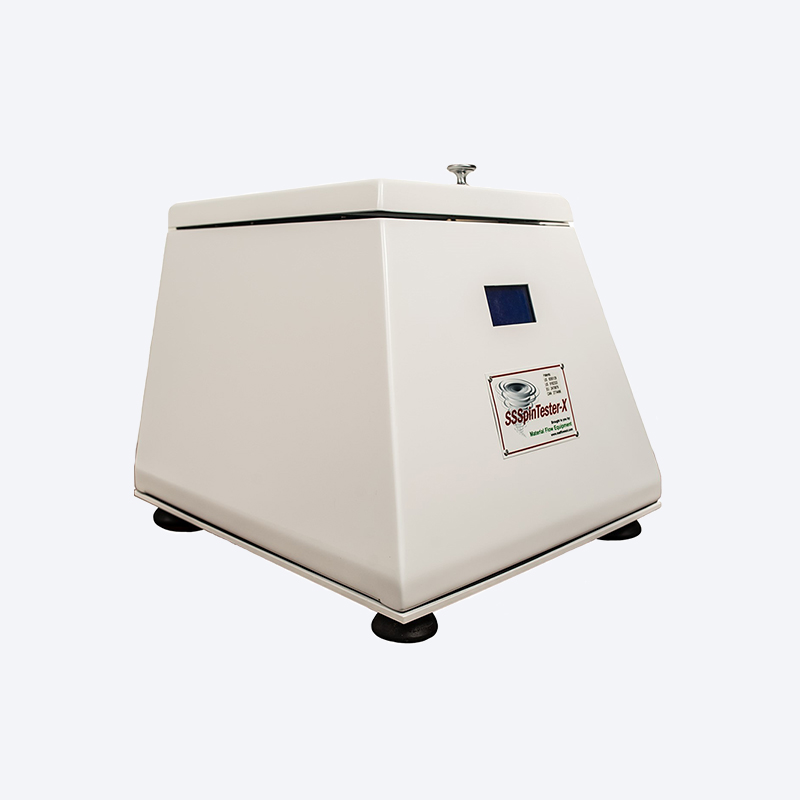
The SSSPin Tester provides repeatable and consistent data by first consolidating the material using centrifugal force to compress the sample inside the sample holder. After the initial compaction step, the SSSpinTester then completes the analysis routine using the same centrifugal force to determine the yield strength of the material.
SSSpinTester Features
- Fast analysis – results in less than fifteen minutes, full 10-point flow function obtained in less than one hour
- Minimal Sample Volume Required – 0.5 cc or less. Minimizes precious or expensive sample waste
- One test acquires full data set – no multiple measurements required
- Extended consolidation pressure range – 0.05 kPa to 72 kPa
- Direct measurement – eliminates the need for extrapolation of data
- Small footprint – requires minimal bench-top space
- Meets Regulatory Requirements – Certified CE compliant and conforms to FDA 21 CFR Part 1
For Formulators, Important Improvements in Analyzing Precious Powders
| Sample Size | Consolidation Pressure | Quick Results |
|---|---|---|
| 0.06 to 0.1gm per test | 10 Pa ot 50 kPa | Single test to obtain data |
| Current testers can require | Current testers can require | Current testers can require |
|---|---|---|
| Greater than 50 gm. | Minumum of 1k Pa | 5 tests to obtain data |
SSSpinTester Specifications
Physical:
- Length: 18in.
- Width: 16in.
- Height: 15in. (includes the feet)
- Mass: ~22.5Kg or ~50lbs
Sample Volume:
Requires 0.5cc per test
Consolidation Pressure Range:
0.05 kPa to 72 kPa
Electrical:
- Voltage: 85 – 264 VAC
- Frequency: 50/60 Hz –
- Single Phase 9A
Environment:
Temperature: 0 to 50 °C (32 to 122 °F) –
With RH maximum of 78%
Typical Applications
Powdered Metals
Obtaining strength values at low consolidation pressures allows prediction of optimal powdered metal behavior. The SSSpinTester can measure the strength of heavy metal powder at actual fill pressure values for direct correlation to processing conditions
Additives (for energy)
Additives are typically introduced to coal combustion streams through pneumatic conveying. Measuring the strength of these powders at low to moderate compaction pressures can help with conveying this material.
Ceramics
Density variations of sintered ceramic powder can cause significant problems with dimensional tolerances of the final parts. Filling pressures are very low and the density variations depend on the strength of the material. Segregation can be prevented by the cohesive properties of the bulk
Pharmaceutical
Strength testing during formulation of pharmaceutical API powders is possible when only a very small quantity of the material is available. The weight variance from tablet to tablet is directly related to how the die fills. The filling depends on the strength of the material at low pressures
Food(fine powders only)
Food engineers need a quick test to measure the cohesion properties (strength and density) to determine if a particular mix will cause flow problems in the unit operation being used at the food plant. The SSSpinTester offers a fast and accurate measure of material strength at a full range of consolidation pressures.
Chemical
Often an engineer wants a quick test to measure the cohesion properties (strength and density) of a particular formulation. The optimal powder is one that has enough cohesion to prevent segregation, but not enough to cause density variations
Catalysts
Measuring the strength of catalyst material at low consolidation pressures can allow the scientist to determine if a catalyst will channel and correlate this information to the life of the catalyst in a fluid bed. The SSSpinTester measures the cohesiveness (strength and density) of the catalyst powder at actual process operating condition
Cosmetics
Decisions can be made regarding the size and shape of the powdered ingredients to optimize packaging success. The SSSpinTester can give the formulator and process engineer the data at actual pressures that are needed for successful packaging