Description
Particle sizing techniques have advanced significantly throughout the past several decades. One of the most important contributions to this field is the application of laser-based technologies, complemented with the use of modern photo-detectors and digital computers. For some time, progress in laser light scattering technology has led to faster analyses, but the quality of the measurement was limited, often due to inadequacies in the detector.
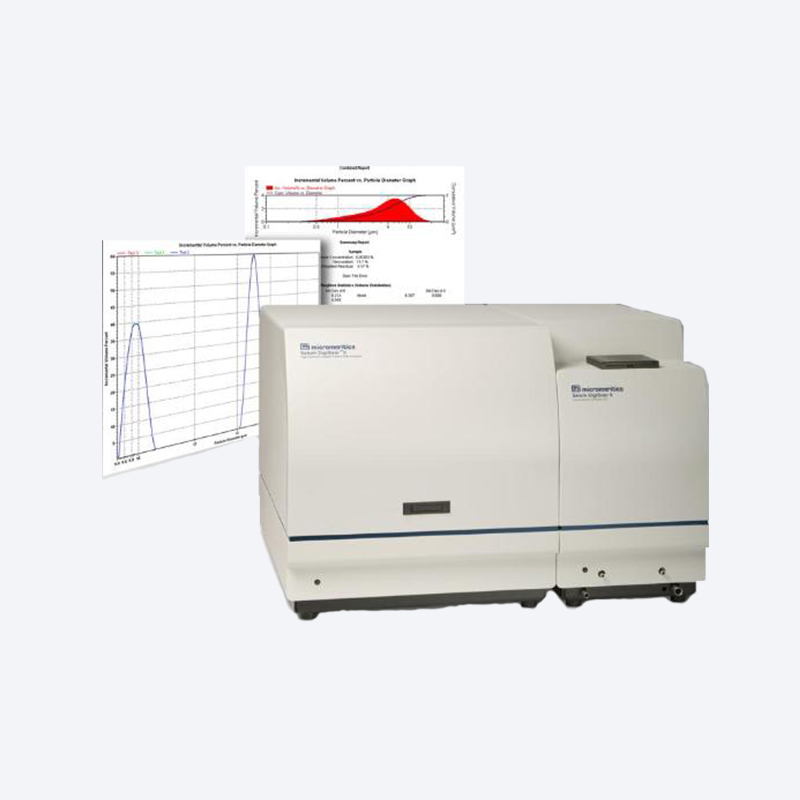
Recognizing this need for better detection capability, Micromeritics developed the Saturn DigiSizer, an instrument that employed a laser diode and modern charge-coupled device (CCD) detector to significantly improve the sensitivity, resolution, reproducibility, and repeatability of the laser light scattering particle sizing technique.
With the Saturn DigiSizer II, Micromeritics has again improved this particle size technique. Utilizing a state-of-the-art CCD detector containing over three million detector elements, Mie theory, and unique design and data reduction features, the Saturn DigiSizer II gives users an extremely high level of resolution and sensitivity not available in other laser particle sizing systems. The level of detail, accuracy, and resolution enables the extraction of all available information from the static light scattering pattern. Users can now measure the same material on multiple instruments located at different locations around the world and get the same, highly detailed size distribution measurement on each instrument. The Saturn DigiSizer II is fully automated and requires little operator intervention.
- Measures both organic and inorganic particles ranging from 40 nanometers to 2.5 millimeters equivalent spherical diameter.
- CCD detector contains over three million detector elements producing extremely high-resolution data.
- Adjustable liquid sample handling unit for automatic sampling, dilution, and dispersion is available in both standard and low-volume configurations.
- One computer can control up to two Saturn DigiSizers each with a liquid sample handling unit.
- Optional MasterTech 052 Autosampler provides unattended analysis of up to 18 samples.
- Fast, detailed results are repeatable on, and reproducible between, every Saturn DigiSizer II.
- User-friendly analysis program includes wizards and intuitive screens and is designed to operate in the Windows® environment
Advantages
- Superior sensitivity
- Higher resolution
- Superior analysis-to-analysis repeatability
- Greater accuracy
- Better reproducibility
- Exceptional data quality
- Fully automated system
- Versatile sample handling options
- Easy-to-use software
- 21 CFR Part 11 software option
- IQ/OQ validation service option
- No proprietary “black-box” algorithms
Applications
Ceramics
Particle Size information helps to determine curing and bonding procedures, control pore structure, ensure adequate green body strength, and produce a final product of desired strength, texture, appearance, and density.
Paints and Coatings
The particle size distribution of the pigment or filler influences the porosity, gloss, texture, color, color saturation, brightness, solids content, and film adhesion properties. The resulting porosity can control application properties such as fluidity, drying or setting time, and film thickness.
Cosmetics
The appearance, application, and packaging of cosmetics are influenced by the particle size distribution of the base powders, such as talc, and the pigments used in coloring.
Abrasives
Performance of abrasives, either in powder form or after being attached to a backing, is dictated by the size distribution of the abrasive powder. Over-sized particles lead to scratching and gouging. Undersized particles may lead to clogging of the abrasive papers.
Catalysts
Flow properties of fluid-cracking catalysts depend upon the particle size distribution of the particles. Surface area and pore structure of acid catalysts and catalyst supports result from the particle size distribution of the particles that are used to produce them
Mining
Refining efficiency of materials is related strongly to the particle size distribution of the raw mineral. For products that are used without chemical change, the size of particles taken from the mine may be too large for final usage. Analyses performed on the extracted minerals will help determine the amount of size reduction needed once the product reaches the processing plant.
Column Packing Materials
The back-pressure of the packed bed within the column is a direct function of the size of the channels through the bed and, thus, the size distribution of the column packing material. Over-sized particles create voids in the bed, reducing efficiency due to remixing of the separated sample components. Undersized particles lead to blockage of flow paths through the bed, increasing the back-pressure and analysis time. A proper distribution leads to greater separation efficiency.
Saturn II DigiSizer Configurations
The Saturn DigiSizer II System
Includes many options that allow you to tailor your instrument according to your specific needs. Multiple sample dispersion system options, an automatic autosampler, and a device for removing dissolved gases from the suspension liquid are available and contribute to the versatility of the system. These options are all designed and manufactured with the same care and attention to detail that produced the Saturn DigiSizer.
Liquid Sample Handling Units
The Saturn DigiSizer II’s sample handling unit ensures that every sample will be correctly dispersed. Micromeritics’ patented, state-of-the-art liquid sample handling units (LSHU) work with the instrument software to assure that sample suspension is of the proper concentration. A continuous flow through the reservoir provides a mixing action sufficient to keep all sample material suspended and prevents the settling of particles.
The LSHU has several automated features such as a built-in ultrasonic probe, automatic liquid level control, particle concentration detection, and a sample circulation system that continuously maintains dispersion. Auto-dispersion and auto-dilution features monitor the sample’s concentration and add liquid as needed until optimum concentration is obtained.
To reduce the possibility of sample carryover between analyses, the LSHU has a patented reservoir rinse design. While other designs simply fill and empty the reservoir to rinse, the Saturn DigiSizer’s LSHU has a feature that sprays the reservoir walls as the fluid level recedes. This removes residue that otherwise might cling to the surface.
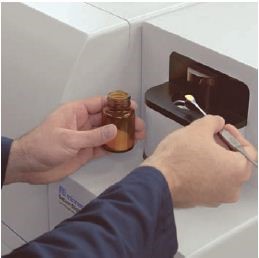
Standard Liquid Sample Handling Unit
The standard unit includes a reservoir that is adjustable between 590 to 690 mL of dispersed sample with a circulation pump rate of 5 – 19 L per minute. It can circulate particles from 0.04 to 2500 µm. The high flow rate better supports particles that have an inherently higher settling velocity. In addition, the higher system clearance helps to avoid attrition of the particles during circulation.
Applications:
- Coarse particles
- High-density particles
- Quantity of sample, liquid supply and/or waste disposal is not a problem
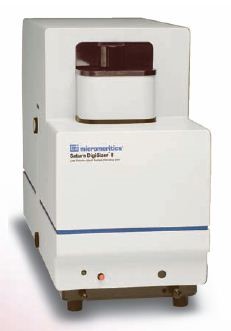
Low-Volume Liquid Sample Handling Unit
The low-volume unit includes a reservoir that is adjustable between 100 to 120 mL of dispersed sample with a circulation pump rate of 2 – 12 L per minute. It can circulate particles from 0.04 to 750 µm in diameter. The low-volume liquid sample handling unit reduces cost by using smaller amounts of sample, and reduces the expense of waste disposal.
Applications:
- Sample quantity is limited
- Supply of dispersion liquid is limited and/or expensive
- Dispersion liquid may be hazardous to use and/or make disposal difficult
Particle Size Sample Preparation Accessories:
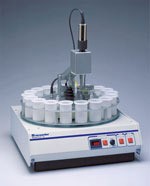
MasterTech Autosampler
The MasterTech Autosampler provides assurance that all samples are prepared and analyzed exactly the same way. The MasterTech is designed to increase throughput, repeatability, and reproducibility while reducing operator involvement. Up to 18 samples can be queued to run sequentially and completely unattended, including automatic stirring or sonication prior to transfer to the analysis system. The Saturn DigiSizer II’s operating software controls the MasterTech, and information about dispersion is stored in the sample file for future reference.
The MasterTech features a powerful ultrasonic probe for sample dispersion. Power to the probe tip is adjustable and the driving circuit is self-tuning for maintaining efficient and consistent sonic energy levels. A front-panel digital readout lets you know when the desired power is reached, and that same power is applied each time the method is repeated.
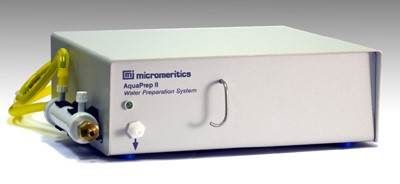
The AquaPrep can prepare 10 liters of water in less than 2 hours (at standard temperature and pressure) and ensures that you obtain the most accurate representation possible of the particle size distribution in your sample.
AquaPrep II
When using water as a suspension liquid during particle size analysis, it is possible for atmospheric gases to be released from solution forming minute bubbles that become incorporated with the sample dispersion. This has a disruptive effect on particle size analysis because the bubbles circulate through the measurement zone of the analyzer and are detected as if they were particles. This can result in the reporting of particle size classes that are not actually present. Removing these bubbles is required for obtaining the most accurate particle size data, particularly when using a highly sensitive analyzer like the Saturn DigiSizer II. Micromeritics’ AquaPrep solves this problem by recirculating water through a hydrophobic capsule consisting of many thin-walled capillaries. A vacuum pump provides low pressure on the outside of the capillaries. The result is a diffusion of dissolved air from the water through the capillary walls and removal through the vacuum pump.
Superior Data Reduction and Reporting
The Saturn DigiSizer II’s powerful, easy-to-use and versatile user interface provides all the convenient features you expect from a Windows-based program such as point-and-click menus, multitasking capability, copy to clipboard, and more. The familiar Windows format reduces the time required for training and eliminates the need for most off-line data manipulation, resulting in increased productivity. The analysis program is designed to operate in the Windows environment and includes wizards and intuitive screens enabling you to perform system operations quickly and efficiently.
In addition, Micromeritics’ confirm™ 21 CFR Part 11 software assists with compliance to FDA regulations. Combined with Micromeritics’ IQ and OQ services, the user can be assured that the Saturn DigiSizer II system is validated for accuracy, reliability, consistent performance, and provides safeguards to protect the integrity of analysis records. System access is limited to authorized individuals. Secure, computer-generated, time-stamped audit trails are integral parts of the software program.
Wide Range of Data Presentation Options With many instruments that employ the static light scattering technique, a final report of reduced data typically is the only output available. The Saturn DigiSizer II, however, allows you to access the raw data. For instance, an image of the scattering pattern (2-D and 3-D representations) can be displayed, or you can receive a 592-point intensity versus angle data report in tabular or graphical form. To allow a quick assessment of the fit of theoretical models to experimental data, you also can obtain an overlay plot of measured data calculated from Mie theory.
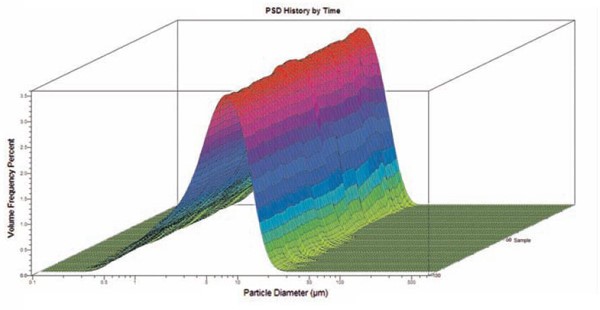
Reduction of Raw Data Based on Mie Theory Ensures Exceptional Data Quality
Micromeritics employs the Mie theory (or the operator can choose to use Fraunhofer for particles that are both large and opaque) to reduce experimental data using a well-published, non-negative least squares method. These theories describe light scattering via theoretical models. No modifications to the theory are made with the Saturn DigiSizer II, and no assumptions of modality or distribution type are used. This is made possible by the remarkably high resolution of the optical system allowing very narrow size classes to be used in fitting the data to Mie theory.
The application of Mie theory provides unambiguous size data. In addition to reporting the data, the Saturn DigiSizer II can generate a plot that shows how well experimental measurements compare with theoretical Mie calculations for the scattering pattern from the reported distribution.
Revolutionary Approach to Particle Sizing
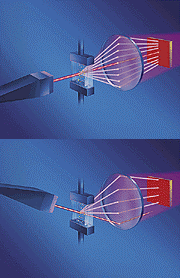
CCDs were originally developed and used for high-sensitivity and high-resolution requirements of imaging for astronomy. The Saturn DigiSizer II captures the scattering pattern using a patented optical design that employs a CCD as the light detector. A high-definition digital representation of the scattering pattern, which contains all of the information required to determine the particle size distribution, is captured.
Micromeritics’ application of the CCD array eliminates the need for mechanical fine-tuning of optical alignment. The instrument is automatically aligned by re-mapping the CCD array so that the scattering angle assigned to each element is exact to less than 0.005 degree relative to the central, unscattered light beam. The Saturn DigiSizer II’s CCD array has more than three million detector elements. The resulting extremely high resolution makes it possible to detect subtle differences in the scattering patterns and, therefore, subtle differences in particle size distributions. These minute differences in sample particle size may indicate a manufacturing variance, corroborate or refute theoretical studies, or help explain natural processes. Higher resolution means greater knowledge about differences between samples.
Advanced design features enable the Saturn DigiSizer to measure a light scattering pattern over a broad range of scattering angles with a dynamic intensity range from 1 to 1×10¹⁰. Combined with the high angular resolution of the CCD, the detector system provides an effective resolution of several million pixels at different positions in the scattering pattern, each detecting minute variations in light intensity. The Saturn DigiSizer’s high resolution enables the instrument to detect extremely small variations in the scattering pattern that are not detected by lower resolution instruments. It is this high level of accuracy that allows the Saturn DigiSizer to provide more detailed and precise particle size information than laser diffraction particle sizing systems of conventional design